Why Learning Words in Context Beats Word Lists (8 Studies)
I used to study vocabulary from frequency lists. Top 1,000 most common Spanish words, organized by part of speech, with clean translations. The words were objectively useful - high-frequency verbs, essential nouns, common adjectives. I'd learn them, review them on schedule, get most of them right on the quiz. And then I'd encounter them in a real article and draw a blank.
Then I started doing something different. Instead of studying from a pre-made list, I started pulling words from articles I was actually reading - a news piece about Spain's economy, a Wikipedia article about Argentine history, a recipe for tortilla española. The words stuck. Not because I studied harder, but because the words meant something to me before I ever made a flashcard.
This isn't just my experience. At least six research traditions in cognitive science and linguistics explain why learning vocabulary in context - especially from content you choose - produces stronger, longer-lasting memories than learning from decontextualized lists. This article covers that research, why it matters, and how to put it into practice.
Why Frequency Lists Feel Efficient but Aren't
Let me be upfront: pre-made vocabulary lists aren't useless. Curated decks organized by frequency, topic, or proficiency level are a genuinely good starting point. They ensure you cover essential vocabulary systematically. Words on Repeat offers 200+ curated decks for exactly this reason - they're structured, they're comprehensive, and they work.
But they have a limitation that becomes clear after a few weeks of study. A flashcard that says "aprender = to learn" is thin. You memorize the pairing, you pass the quiz, but the word hasn't really landed anywhere in your mind. There's no scene attached to it, no article you remember reading, no moment where you needed that word to understand something you cared about.
Now compare that to encountering "aprender" in a real sentence from an article about education reform: "Los estudiantes deben aprender a pensar críticamente." You're not just memorizing a translation - you're processing meaning in a real context, connecting the word to a topic, and doing it because you wanted to understand the article.
That gap - between shallow memorization and deep contextual processing - is exactly what cognitive science has spent 50 years studying.
Levels of Processing - Why Depth Beats Repetition
In 1972, Fergus Craik and Robert Lockhart proposed a framework that changed how psychologists think about memory. Their "Levels of Processing" theory argues that how deeply you process information at the moment of encoding determines how well you'll remember it - and depth matters far more than repetition.
They identified three levels. Structural processing is the shallowest - noticing what a word looks like, its letter patterns, its visual form. Phonological processing is intermediate - hearing the word, rehearsing its sound. Semantic processing is the deepest - understanding what the word means, how it connects to other concepts, what role it plays in a sentence.
When you study "desempleo = unemployment" from a frequency list, you're mostly doing phonological processing. You rehearse the pairing, maybe say it aloud a few times. But when you encounter "desempleo" in a news article about Spain's youth unemployment rate - "El desempleo juvenil supera el 30%" - you're forced into semantic processing. You notice the prefix "des-" (un-), connect it to "empleo" (employment), anchor it to a real-world topic, and evaluate whether you already knew a related word. That's deeper, and deeper means more durable.
The implication for vocabulary learning is straightforward: any method that forces you to process meaning - not just form - will produce better retention. Context-based learning does this naturally, because you can't understand a word in a real sentence without processing what it means.
Why the Right Kind of Effort Matters
Craik and Lockhart showed that depth matters. In 2001, Jan Hulstijn and Batia Laufer showed that the right kind of effort matters just as much.
Their Involvement Load Hypothesis identifies three components that determine how well a new word is retained: Need (do you need this word?), Search (do you look up its meaning?), and Evaluation (do you compare it with other words or decide how to use it?). The higher the total involvement across these three components, the better the retention.
In their experiments, students who encountered words in a composition task (high involvement: they needed the word, searched for it, and evaluated how to use it) remembered significantly more words than students who simply read a text with glossed definitions (low involvement: the meaning was handed to them, no evaluation needed).
Here's how pre-made lists compare to learning from your own content:
| Component | Pre-Made List | Your Own Article |
|---|---|---|
| Need - motivation to learn | Low - assigned by the list | High - you need it to understand what you're reading |
| Search - looking up meaning | None - translation is given | Moderate - you look it up, or AI extracts it with context |
| Evaluation - comparing and using | Low - no surrounding context | High - the sentence forces you to evaluate meaning |
| Total Involvement | Low | High |
This isn't about studying harder. It's about the task design creating the right cognitive effort naturally. When you're reading an article and you stumble on a word you don't know, you already have high Need - you want to understand the sentence. When you look it up (or extract it with AI), you're doing Search. And when you see the word in its original sentence, compare it with words you already know, and decide whether to save it, you're doing Evaluation. The involvement load is high without any extra work on your part.
The Autonomy Effect - Why Choosing Your Content Matters
There's another dimension the processing theories miss: motivation.
Edward Deci and Richard Ryan's Self-Determination Theory, first published in 1985 and now one of the most cited frameworks in educational psychology, identifies three fundamental drivers of intrinsic motivation: autonomy (I chose this), competence (I'm getting better at this), and relatedness (this connects to something I care about).
When you choose the article you read - say, a tech review blog in German because you actually want to know which laptop to buy - all three drivers activate at once. Here's how they compare:
| SDT Driver | Textbook Assignment | Content You Chose |
|---|---|---|
| Autonomy - "I chose this" | Low - assigned by curriculum | High - you picked the article or video |
| Competence - "I'm improving" | Delayed - feedback comes from grades | Immediate - you understand more of the text as you learn |
| Relatedness - "This matters to me" | Weak - topic may not interest you | Strong - topic connects to your real life and goals |
No textbook assignment triggers all three at once. That's why the same student who procrastinates on homework will voluntarily spend an hour reading about their favorite topic in a foreign language.
A 2024 meta-analysis published in Educational Psychology Review synthesized decades of research on personalized learning materials. Students learning with materials matched to their interests consistently outperformed those using generic materials - not because the content was objectively better, but because the motivation to engage with it was higher. The effect sizes were substantial across all three measured outcomes:
I noticed this personally when I started learning Polish from tech articles instead of textbook exercises. Reading about a topic I already cared about - a product review, a coding tutorial - made the vocabulary feel like a means to an end rather than an end in itself. The words weren't homework; they were keys to content I wanted to access. That shift in motivation changed everything about how well I retained them.
Context Is Part of the Memory
Here's something that isn't obvious until you think about it: the context in which you learn a word becomes part of the memory itself. Three research traditions explain why.
Knowledge is situated, not abstract. John Seely Brown, Allan Collins, and Paul Duguid argued in their influential 1989 paper on Situated Cognition that knowledge is embedded in the activity, context, and culture where it was learned. A word you learn while reading about climate change gets stored alongside that conceptual frame. When you encounter climate-related content again, the word resurfaces more easily than if you'd learned it from a generic list.
Words need multiple meaningful encounters. I.S.P. Nation, in his comprehensive 2001 book Learning Vocabulary in Another Language, makes the case that vocabulary learned from context may be the most important pathway for second-language learners. He notes that words typically need 6-12 meaningful encounters before they're truly acquired. When your flashcard's example sentence comes from the actual article you read, your first review already counts as a meaningful re-encounter - you remember the article, the topic, the sentence, and the word's role in it. Generic example sentences can't do that.
Video adds a second memory channel. Allan Paivio's Dual Coding Theory, developed in 1971, shows that information encoded through both verbal and visual channels produces stronger memories than either channel alone. When you learn the Spanish word "tormenta" (storm) from a weather video where you can see the dark clouds and rain, you're encoding the word in two systems - a verbal label and a visual scene. Two memory codes are more durable than one.
These three mechanisms compound. Here's the practical difference when you sit down to review:
| During review, you recall... | Generic Flashcard | Contextual Flashcard |
|---|---|---|
| Word + translation | Yes | Yes |
| Example sentence | Generic dictionary example | The actual sentence from your article or video |
| Topic or scene | Nothing specific | The article's subject, the argument being made |
| Emotional connection | None | Your interest in the topic that drew you in |
| Visual memory (video source) | None | The scene, the speaker, the setting |
| Counts toward 6-12 encounters? | Partial - isolated repetition | Yes - rich, meaningful re-encounter |
The bottom row matters most. Nation's research shows that passive repetitions (seeing the same word-translation pair over and over) contribute less toward acquisition than meaningful encounters where you process the word in context. A contextual flashcard review is a meaningful encounter; a generic flashcard review often isn't.
Six Theories, One Conclusion
These research traditions come from different decades, different disciplines, and different methodological approaches. But they converge on the same finding.
Levels of Processing says context forces deeper encoding. The Involvement Load Hypothesis says context creates the right kind of cognitive effort. Self-Determination Theory says choosing your own content activates intrinsic motivation. Situated Cognition says context becomes part of the memory trace. Dual Coding says multimedia content creates two memory codes instead of one. And Krashen's Comprehensible Input Hypothesis says authentic materials at the right level provide the exposure that drives acquisition.
Each of these mechanisms independently improves retention. When you learn vocabulary from content you chose to read or watch, all six activate simultaneously. That's not additive - it's compounding.
How to Learn Vocabulary From Your Own Content
So what does this look like in practice? Here's the workflow I use.
Step 1: Find content in your target language. News articles, YouTube videos, Wikipedia pages, recipes, blog posts, podcast transcripts. The only rule: pick something you'd actually want to read or watch even if you weren't studying. If you're into cooking, read recipes in Spanish. If you follow tech news, read a German tech blog. If you watch travel vlogs, find one in French.
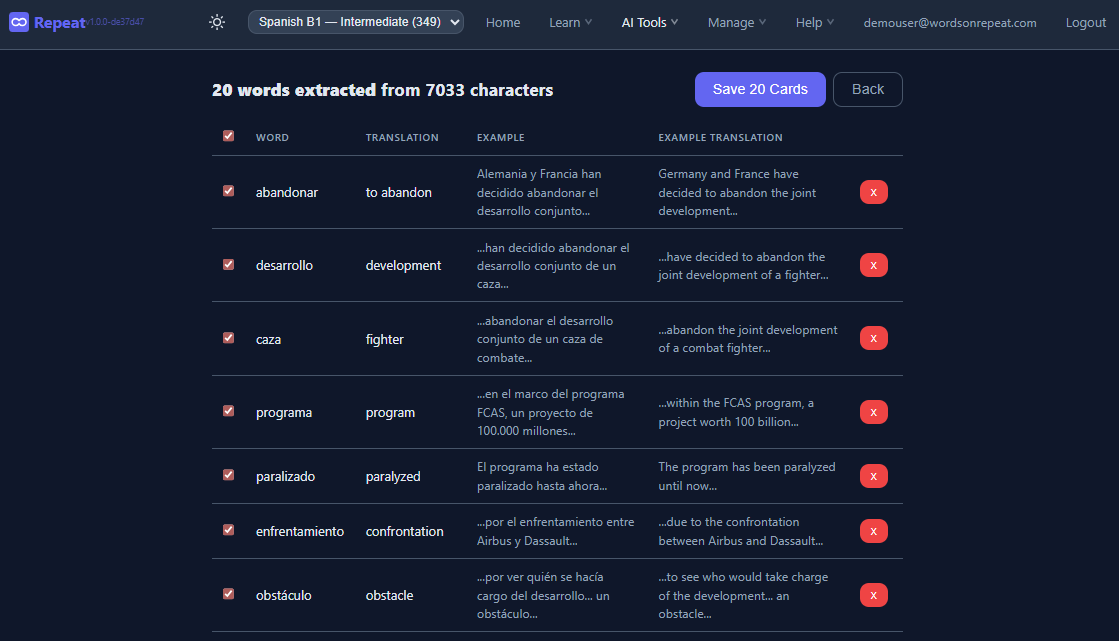
Step 2: Extract the vocabulary. Don't try to learn every unfamiliar word - focus on the ones that block your comprehension. In Words on Repeat, you can paste the URL, drop in the text, upload a PDF, or import YouTube subtitles, and the AI extracts vocabulary with translations and example sentences pulled directly from the source. For a full walkthrough of all four input methods, see the AI Flashcard Generator guide.
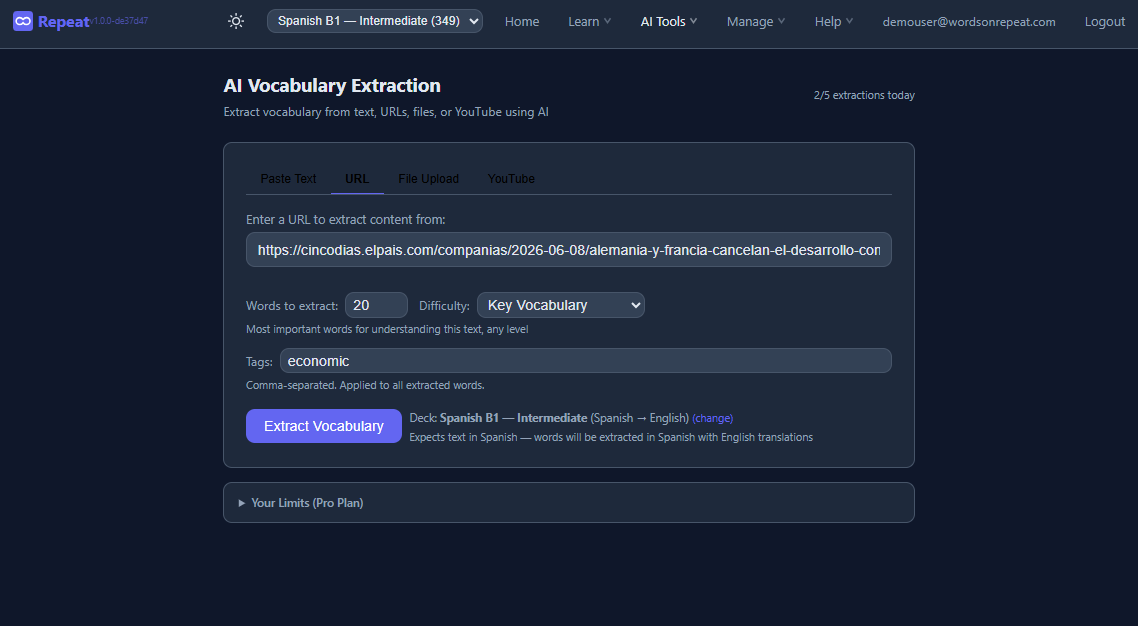
Step 3: Keep the original context. This is the key. The example sentences on your flashcards should come from the content you read - not from a generic dictionary. When you review the flashcard, you'll remember the article, the topic, and the sentence, and the meaning clicks faster.
Step 4: Review with spaced repetition. Context gets the word into memory; spaced repetition keeps it there. FSRS schedules each review at the moment you're about to forget - challenging enough to strengthen the memory, but not so late that you've already lost it.
Step 5: Return to the source. Re-read the article or re-watch the video after a few days of studying the extracted words. You'll understand more of it than you did the first time. That moment - when a sentence that was opaque becomes clear - is the feedback loop that keeps the habit going.
Why Context and Spaced Repetition Compound
Context and spaced repetition aren't competing approaches - they're complementary, and together they're more effective than either alone.
Context provides the deep initial encoding. When you learn a word from an article you care about, the memory trace is rich from the start - anchored to a topic, embedded in a sentence, connected to your motivation. But even rich initial encodings fade without reinforcement. That's where spaced repetition comes in: it provides the retrieval practice that consolidates the memory over time, scheduling reviews at the moment each word is about to be forgotten.
The combination compounds. A word learned from a list and reviewed with FSRS will be retained - but each review is effortful because the initial encoding was thin. A word learned from a meaningful article and reviewed with FSRS is easier to recall each time, because the context resurfaces with it. The review feels less like work and more like remembering.
Neither approach is sufficient alone. A rich initial encoding without any review still fades - Ebbinghaus showed that 140 years ago. And spaced repetition with a shallow initial encoding works, but each review feels harder because there's nothing to latch onto. The combination - meaningful context at encoding, FSRS-optimized retrieval practice after - is where the compounding happens.
Frequently Asked Questions
Do I still need curated decks if I'm learning from my own content?
Yes - they're complementary, not competing. Curated decks ensure you cover essential high-frequency vocabulary systematically. Contextual learning fills in the words specific to topics you care about. Most learners benefit from both: a curated deck for the foundation (especially at A1-A2 levels), plus vocabulary extracted from content they're reading. Browse 200+ curated decks for your foundation.
How many words should I extract from a single article?
Start with 5-10 words per article. Focus on words you need to understand the text, not every unknown term. Nation's research suggests 95% text coverage is the threshold for comfortable reading comprehension - you don't need to look up every rare word. Extracting too many at once also dilutes the contextual connection; each word gets less attention during the preview step.
Does this work for languages with non-Latin scripts (Japanese, Chinese, Korean)?
Yes. The cognitive principles are universal - depth of processing, situated cognition, and dual coding all apply regardless of writing system. Dual coding is especially powerful for logographic scripts: seeing a kanji in a real sentence alongside its pronunciation and meaning creates a rich, multi-layered memory trace. Words on Repeat automatically adds romanization (romaji, pinyin, romanized Korean) to extracted cards from these languages.
Is watching YouTube in a foreign language enough, or do I need to study the words separately?
Exposure alone is valuable but insufficient for most learners. Krashen's input hypothesis supports exposure, and it does build passive comprehension over time. But Nation's research shows that words typically need 6-12 meaningful encounters before active acquisition - and passive watching provides only one or two of those. Extracting key words into flashcards and reviewing them with spaced repetition gives you those repeated encounters efficiently, turning passive exposure into active vocabulary.
You don't need to change how you consume content - you just need to extract vocabulary from what you're already reading and watching. Find an article in your target language, paste the URL into the AI Extract page, and pull out 10 words with their original sentences. That's the contextual learning loop in practice: real content, real sentences, real retention. Not sure how big your vocabulary is right now? Take the free vocabulary size test to get a baseline, then start with 5 free extractions per month or browse 200+ curated decks to build your foundation first.
References
- Craik, F.I.M. & Lockhart, R.S. (1972). "Levels of Processing: A Framework for Memory Research." Journal of Verbal Learning and Verbal Behavior, 11(6), 671-684. doi:10.1016/S0022-5371(72)80001-X
- Hulstijn, J.H. & Laufer, B. (2001). "Some Empirical Evidence for the Involvement Load Hypothesis in Vocabulary Acquisition." Language Learning, 51(3), 539-558. doi:10.1111/0023-8333.00164
- Krashen, S.D. (1985). The Input Hypothesis: Issues and Implications. Longman.
- Brown, J.S., Collins, A. & Duguid, P. (1989). "Situated Cognition and the Culture of Learning." Educational Researcher, 18(1), 32-42. doi:10.3102/0013189X018001032
- Nation, I.S.P. (2001). Learning Vocabulary in Another Language. Cambridge University Press.
- Deci, E.L. & Ryan, R.M. (1985). Intrinsic Motivation and Self-Determination in Human Behavior. Springer. doi:10.1007/978-1-4899-2271-7
- Paivio, A. (1971). Imagery and Verbal Processes. Holt, Rinehart, and Winston.
- Lin, L., Lin, X., Zhang, X. & Ginns, P. (2024). "The Personalized Learning by Interest Effect on Interest, Cognitive Load, Retention, and Transfer: A Meta-Analysis." Educational Psychology Review, 36, 88. doi:10.1007/s10648-024-09933-7